
By Atilio A. Boron June 5, 2026
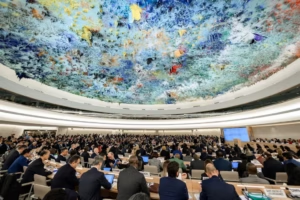
Human Rights Council at the United Nations in Geneva, Switzerland, foto: Reuters/Denis Balibouse
The defense of human rights and the popular demand encapsulated in the slogan “memory, truth, and justice” are the most illustrious hallmarks of Argentine democracy. If my memory serves me correctly, this country was the only one that, upon restoring democracy, brought to justice the members of the three military juntas that ravaged the country between 1976 and 1983. In Brazil, a country where the military dictatorship lasted twenty-one years, President Dilma Rousseff—a former political prisoner tortured by the dictatorship’s henchmen—created the National Truth Commission (CNV) shortly after taking office. A laudable intention, but from the outset the military made it clear to her that the commission’s functions were to be exclusively investigative and that, unlike what happened in Argentina, it would have no authority whatsoever to bring those implicated in the repression carried out by the military regime to justice. The reason? The military’s enormous influence in Brazilian politics, reflected, among other things, in the continued validity of the Amnesty Law enacted by the regime in 1979. In Guatemala, dictator Efraín Ríos Montt, who presided over a military junta between 1982 and 1983, was sentenced to 80 years in prison for the crimes of genocide and crimes against humanity committed in the massacre of 1,771 Ixil indigenous people. Ten days after the verdict was announced, Guatemala’s Constitutional Court overturned it due to alleged procedural violations. Ríos Montt died a free man. In Chile, numerous military personnel were prosecuted and convicted of human rights violations, but none of the members of the Junta were ever put on trial. Pinochet faced criminal proceedings in London at the behest of Spanish judge Baltasar Garzón; although this kept him in that city for just over a year, it did not prevent him from later returning to Chile and living out the rest of his days in freedom.
Given this background, the Argentine government’s recent decision to withdraw from participating in the recent Human Rights Council meeting held in Geneva reveals the Copernican shift that Javier Milei’s government has imposed on the human rights policy that had been upheld by successive governments of various political stripes since the restoration of democracy in December 1983. This hallmark of honor that made Argentina’s democratic process an object of admiration worldwide has been thrown in the trash by the hot-headed troublemaker who occupied the Casa Rosada. This initiative by Milei’s autocratic regime—a characterization based on the executive branch’s repeated violations of the republic’s institutional order—is in line with the decision adopted by the Trump administration to withdraw the United States from 66 international organizations, including the UN Human Rights Council. Not only that: in a decision also adopted by the Argentine government, Trump withdrew from the World Health Organization, the Paris Agreement on Climate Change, and UNESCO. It is no secret that Trump and the American far right have launched a crusade to dismantle the institutional framework inherited from World War II, which, while in need of urgent reform, does not mean it should be destroyed. True to this regrettable decision, the United States has become the UN’s largest historical and current debtor, responsible for more than 95% of that international organization’s total deficit. Its accumulated debt stands at around $5.3 billion, and the White House has shown no signs of wanting to resolve this situation as soon as possible.
The suicidal blind following of Argentine foreign policy reached scandalous extremes when, at the General Assembly session on March 25, 2026, Argentina, along with the United States and Israel, was one of only three countries to vote against a resolution formally establishing that the transatlantic slave trade was “the most serious crime against humanity in history.” A total of 123 countries supported this resolution, primarily members of the African Union, CARICOM, and nearly all Asian countries. There were 52 abstentions, mainly from European Union countries. With this irrational stance, Argentina will be in a very unfavorable position ahead of the upcoming meeting of the UN Special Committee on Decolonization (June 15–26) when the time comes to vote again on a resolution urging the governments of the Argentine Republic and the United Kingdom to enter into negotiations aimed at achieving a peaceful and definitive solution to the sovereignty dispute over the Falkland Islands, South Georgia, and the South Sandwich Islands and the surrounding maritime areas. The vote of the countries of the Global South has always been decisive in securing that diplomatic victory year after year. Now, the reactionary blunder of the Milei government in rejecting the aforementioned resolution on the slave trade could, for the first time, put an end to that crucial support. This is one of the costs—and not the most burdensome—of the policy of automatic alignment with the United States pursued by Javier Milei’s neocolonial government, which to date has visited the United States 17 times. It is difficult to find in world history a head of state of a colony who has made the pilgrimage to the metropolis as frequently as Milei has. The damage that this abject subservience has inflicted on Argentina—and the damage this country will suffer in the coming years—is immeasurable. Milei sees himself as “the mole who came to destroy the state from within.” He failed to mention that in doing so, he would also cause damage—perhaps irreparable—to Argentina’s future as a nation.
Source: Pagina 12, translation Resumen Latinoamericano – English