
By Sergio Zabalza on March 20, 2026
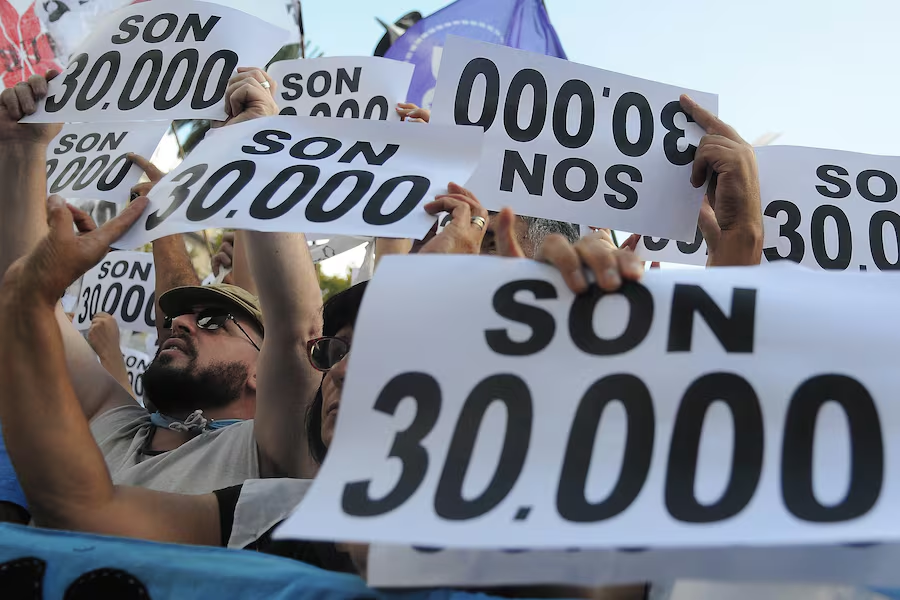
there are 30,000
March 24, 1976, marked a turning point in Argentine history. It was the date on which, to shift the pattern of wealth accumulation in favor of financial capitalism, a de facto government imposed state terrorism across the entire Argentine territory. The Argentine Military Junta resorted to urban guerrilla tactics to justify the most atrocious extermination program that our Latin America had known since independence from Spain and Portugal, including death camps and death flights. The figure of 30,000 people kidnapped, tortured, and disappeared, plus hundreds of abducted children, reflects the horror that economic power orchestrated—and that the military carried out—with the acquiescence of the Church and the mainstream media and the support of parts of civil society. A set of factors whose sinister collaboration is summed up in the phrase that, like no other, bears witness to the effects of insidiousness toward one’s neighbor in the social sphere: “He must have done something.” That is: while support is given to the authorities to justify a crime, the victim’s environment is plunged into isolation, suspicion, and guilt. If we take note that this procedure was replicated millions of times, we can clearly see the level of degradation into which Argentine society fell during those dark and ominous years.
The issue is that the state terrorism of the so-called National Reorganization Process revived a figure—by no means new in the history of human tragedy—whose traumatic essence strikes at the very heart of existence: the disappeared. That is to say, the person of whom there is no trace of their fate; of whom it is unknown where or why, from one day to the next, they are no longer there. That comrade; brother or sister; son or daughter; spouse; friend—for whom there is no information or possible explanation to deduce any clue as to their fate, other than the treacherous abduction by an inhumane regime. There is likely no psychological torture more acute than the suffering experienced by a disappeared person. The person kidnapped or disappeared by state terrorism blocks any possibility of processing within the psyche. In fact, to make it clear that villainy and nonsense can go hand in hand, the genocidal Jorge Rafael Videla attempted to invoke this notion when referring to the tragedy of the disappeared: “The disappeared person has no entity; they are neither dead nor alive; they are disappeared,” he said unflinchingly in front of the cameras, perhaps in the most brazen and cynical statement our memory can recall. To put it bluntly: the figure of the disappeared plunges a person into the paralysis of the emotional apparatus, as it prevents the most important act of psychological processing: mourning. Without mourning, there is no psychological work. And if, as Plato says, to love is to give what one does not have (to surrender one’s lack to make room for someone else), without mourning, love is impossible.
In fact, without mourning there is no conviction either, only delusional certainties. Conviction is reached as the product of intellectual work that discards (accepts losing) some hypotheses to preserve others; certainty, on the other hand, bursts in to impose itself on the psyche regardless of any dialectic or reason. If there is no mourning, one ends up talking to dead dogs, so to speak.
March 24, 1976, marks a turning point in the life of this nation. It is the moment when a social body stands at the edge of existence or, conversely, succumbs to ignominy—a word whose etymology, not for nothing, means “nameless.” That frontier that only the classics—by traversing every era and culture—manage to represent in immortal fictions. The fact is that just a few months after the establishment of a regime at odds with the human condition, the epic of Antigone resurfaced. “Move along!” ordered a police officer to some “crazy old women” who—stationed on an iconic plot of land—were demanding answers about the fate of their sons and daughters. They wanted to know. Since then, the Mothers of Plaza de Mayo have not stopped circulating to show the world that we speaking beings are more than just objects meant to be produced and then left to die when the market discards us. It is no coincidence. Antigone rebelled against the tyrant. She confronted him to honor the immemorial law by which a inscription bearing the deceased’s name lies upon their grave. For many, this is the gesture with which civilization itself begins. The pillar of Justice.
Sadism has always consisted of taking pleasure in harming one’s fellow human beings. If a wild beast kills to eat, the sadist makes a person disappear to enjoy the suffering of their loved ones. Cruelty is turning one’s neighbor into an object to enjoy the pain of others. This was state terrorism. This is precisely what drives the deranged policies of the libertarian administration. Many wonder how it is possible that, after such an atrocious experience, Argentina has a government that vindicates the perpetrators of state terrorism. The answer lies in the darkest and most complex recesses of the constitution of speaking bodies: human beings, that is. The fact is, unlike the rest of the creatures on the planet, we speaking beings are not governed by instinct. We are dominated by a chaotic impulse that does not know what it wants or why it exists, and that may well be directed toward the most sublime ends—be it art, science, solidarity—or the cruelty we mentioned above.
Take, for example, the tweet a presidential advisor posted some time ago, in which he emphatically stated that socialism (read: anyone who doesn’t think like him) must be eliminated, made to disappear. The use of this last word in a country torn apart by the tragedy of 30,000 disappeared persons and hundreds of appropriated children is no accident. It stems from the exercise of cruelty. Cruelty as state policy. The libertarian government wants to make Argentina—which still retains institutional traits of solidarity, equality, and respect for human rights—disappear. The infamous labor reform is a step in that direction. Our response must be categorical.
Beyond the insatiable and sadistic drive of the libertarian administration, we Argentines must appear. In the streets. In the marches. In the protests. In the factories. In the hospitals. At the university, in the schools. And before ourselves. What is at stake is an essential part of our subjectivity. More than ever, the demand for the disappeared entails safeguarding the Other that dwells within our innermost selves. When that otherness that constitutes us is repressed—and let this term carry all its resonance—all that remains is “self-hatred,” that passion prior to the moral conscience that preserves coexistence, good faith, and our love.
See you on the 24th in the Plaza.
Source: Pagina 12, translation Resumen Latinoamericano – English
 In memory of the founder of Resumen Latinoamericano in English, Alicia Jrapko, who lost many close friends and was forced to flee her Argentine homeland in 1976