
By Atilio A. Boron on July 3, 2026 in Buenos Aires
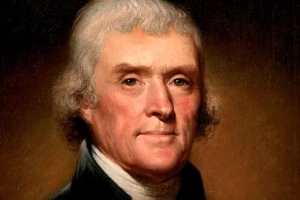
Thomas Jefferson, who owned more than 600 slaves throughout his life, none of whom were ever freed.
This July 4 marks the 250th anniversary of the Declaration of Independence of the thirteen British colonies established in North America. The date marks the birth of what Seymour Martin Lipset called the “first new nation”, one of whose characteristics was that it was created without having to grapple with the authoritarian and elitist baggage of a monarchical and feudal past. According to this author, this circumstance led the United States to exalt equality and individual achievement and to reject state interference in social life, a trait characteristic of European monarchies. This would be the core of what is known as “the American creed,” sometimes also called “the American Dream,” and supposedly enshrined by the Founding Fathers in the United States Constitution.
However, a closer look at the evolution of American society reveals that its early formation as a bourgeois society did not exempt it from harboring within its ranks the contradictions and conflicts inherent in capitalism—including a dramatic process, accelerated over the last half-century, of growing inequality and the concentration of wealth. In 2024, the United States’ Gini coefficient stood at 41.8—very close to that of a country like Cameroon (42.2) and far from the figures seen in the old, elitist European monarchies: 23.4 in Belgium, 33.5 in the United Kingdom, and 30.4 in France. In other words, the “American Dream”—if it ever existed in the early stages of the United States’ formation—has turned into the nightmare of classism, exclusion, prejudice, and discrimination that the country suffers from today, with tens of millions of citizens lacking housing, healthcare, education, and social security.
The same can be said of the iconic phrase from the U.S. Constitution: “All men are created equal,” drafted by none other than Thomas Jefferson (photo), who owned more than 600 slaves throughout his life, none of whom were ever freed. It is no small matter that of the 56 signers of the Declaration of Independence, 41 were slave owners and opposed including in the constitutional text—as someone had proposed—an explicit ban on the slave trade. The most notable exceptions were John Adams and Alexander Hamilton, who never owned slaves.
Unlike Washington, Jefferson, and so many others, Bolívar freed the slaves inherited by his family shortly after the Battle of Carabobo in 1821. In short: when the Founding Fathers spoke of all men being born free, they were actually referring to white men—and, above all, to the most educated among them. The rustic “Farmer”—generally regarded as “rebellious rabble”—did not qualify for that status either, hence the need to create electoral colleges to mediate the political will of the populace. Even worse was the exclusion of that egalitarian principle when it came to the indigenous peoples of North America, slaves, and, of course, women.
The much-lauded U.S. Constitution also suffers from a notable omission: the word “democracy” does not appear anywhere in the text, nor did it appear in the old Argentine Constitution of 1853, which was very specifically inspired by its American counterpart. The goal was never—and certainly not today—to create a genuine democracy. Abraham Lincoln summed up the democratic project in his famous phrase: “Government of the people, by the people, and for the people.” He uttered these words in his Gettysburg Address in November 1863; a year and a half later, he would be assassinated. In fact, the United States has never been a democracy but rather a plutocracy cloaked in pseudo-democratic trappings and rituals. Today more than ever.
Finally, a key point in characterizing the United States as the last global hegemon, now in clear retreat. Former President Jimmy Carter provided this insight in April 2019 during his address at the Plains Baptist Church in Georgia, when he said that “the United States was the most warmongering and bellicose nation in world history” and that it had been at peace for only 16 of its 242 years as an independent nation. Today, we could say the same about its 250 years as an independent nation. According to Carter, this endless history of wars has bled the country dry economically, and he concluded by saying that if China grew as phenomenally as it did, it is because, since the founding of the People’s Republic in 1949, it has never been at war with anyone. We, he said, have always been waging wars abroad.
This July 4th finds the United States at war in the Middle East, suffering a setback to its plans in Iran, and waging a proxy war through its European vassals against Russia. Furthermore, it is threatening to annihilate civilizations, destroy economies through brutal unilateral coercive measures, and bring Greenland—and, just a few days ago, Venezuela—under U.S. jurisdiction by force. A regrettable outcome for that war of national liberation against British despotism, which, two and a half centuries later, concludes its historical journey as a decaying empire that has become the greatest threat to world peace.
Source: Pagina 12, translation Resumen Latinoamericano – English