
By Vijay Prashad on August 18, 2026
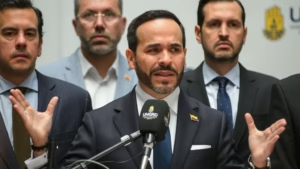
Colombia’s President Abelardo de la Espriella speaks after leading and earthquake response meeting in Bogota, , Aug. 10, 2026. Photo: AP
In August, right-wing billionaire Abelardo de la Espriella took over as president of Colombia and vowed to push for a far-right agenda, despite having won by less than a percentage point against left-wing candidate Ivan Cepeda. It is characteristic of a special kind of extreme right to assume any mandate and pretend that it has the authority to transform society into its toxic swamp. Of the twenty states that are generally considered part of Latin America, eleven now have far-right governments: Argentina (Javier Milei since 2023), Bolivia (Rodrigo Paz from 2025), Chile (José Antonio Kast since 2026), Colombia (from the Espriella since 2026), Costa Rica (Laura Fernández since 2026), Ecuador (Daniel Noboa from 2023), El Salvador (Nayib Bukele since 2019), Honduras.
Most of these leaders do not come from the old conservative circle, but are part of a new generation (Noboa is the youngest of the group, born in 1987) with an average age of 52. These are men and women who represent the ancient oligarchies of Latin America, the old families with deep colonial roots and vast properties; however, these leaders do not have an aristocratic sensibility or come from established conservative political parties. They are libertarian in nature and show brazen loyalty to the United States and its agenda. They present themselves as patriots, but their patriotism is relegated to absolute loyalty to Washington and its corporations.
Shoot to kill
The far right arises from a long tradition of lawless violence by the oligarchy, dating back from genocide against indigenous peoples to the military dictatorships of the Operation Condor era. Impunity in the face of violence has been the hallmark of this class and its political representatives, so the current extreme right is only faithful to its class and its ancestors. Laura Fernández was born in 1986, a year before Costa Rican President Oscar Arias won the Nobel Peace Prize for her work in resolving conflicts in Central America (Costa Rica stripped of its army in its 1949 Constitution). In his inauguration in May 2026, Fernández declared that he would have a “hard-handed response” to crime and that his “hand will not tremble.” After Gustavo Petro’s attempts to reach peaceful resolutions to the conflicts in Colombia, De la Espriella took office with the opinion that “criminals can also receive bullets,” suggesting a return to the state of war.
Nayib Bukele’s heavy-handed approach to crime has profoundly influenced Latin America’s far-right, turning massive detentions, military deployments, the state of emergency and El Salvador’s mega carcels into a regional political model. Leaders and candidates from Ecuador, Colombia, Costa Rica, Peru, Chile and other countries increasingly present crime as a war that requires exceptional state power, rather than conventional police and social policies. Bukele’s popularity has helped normalize promises of militarized streets, harsher sentences, expanded prisons and fewer procedural guarantees. Although critics document arbitrary detentions and human rights abuses, their fans describe their methods as proof that decisive and authoritarian leadership can restore order where democratic institutions seem ineffective. So far, the extreme right of a special kind has presented its anti-liberal approach to crime – in fact, towards the neighborhoods of the poor – as the only effective solution to drug-mafias and minor neighborhood criminals.
Reversal of social achievements
Throughout Latin America, the “Furious Tide” is trying to reverse feminist achievements by restricting abortion and contraception, dismantling institutions that address gender-based violence, attacking sex education, and presenting feminism as a threat to the traditional family. In Argentina, the government of Javier Milei closed the Ministry of Women, suspended the national distribution of abortion drugs and cut out anti-conception and adolescent pregnancy prevention programs, which has made formal rights increasingly inaccessible, especially for poor and working-class women.
In Chile, far-right lawmakers have proposed forcing women to listen to the heartbeat of the fetus before it can access one of the abortions the country allows in a very restricted way, while several new bills would punish the allegedly “false” accusations related to rape, sexual abuse and domestic violence. These proposals could allow an accused person to take legal action against the person who filed the complaint once the case is dismissed and therefore intimidates survivors; in class terms, this threat rests with greater force on working-class, rural, migrant and indigenous women who lack lawyers, economic resources and institutional protection, which reinforces patriarchal control while making access to justice more dangerous.
Blindness to the genocide
The extreme right not only today considers out-of-law violence as its currency, but it habitually celebrates the history of the conquistadors against the indigenous peoples of the Americas, as well as the whole panoply of Western civilization (as Milei did in his speech in Davos in 2024). Cegonide blindness is a habit of the extreme right, which is why it has absolutely no qualms about maintaining close relations with the United States and its policy of seeking the subordination of the entire hemisphere of the Americas to Washington’s interests. When Washington claims that the path to close ties with it must pass through Tel Aviv, far-right governments are rushing to forge close relations with Israel – despite the ongoing genocide against the Palestinians.
In June 2025, Argentina’s ambassador to Israel, Rabbi Shimon Axel Wahnish, announced something called the Isaac Accords, designed to establish a close relationship between Latin American countries and Israel. The announcement came nearly two years after the genocide began, although the Isaac Accords themselves were formally established in April 2026 in Jerusalem. While Argentina and Israel are the only formal signatories, in May, a conference held in Buenos Aires brought together officials from Bolivia, Brazil, Chile, Colombia, Costa Rica, Ecuador, El Salvador, Guatemala, Honduras, Panama, Paraguay and Uruguay, who signed a declaration calling for the expansion of the Isaac Accords. In addition, Bolivia (2025) and Colombia (2026) have re-established diplomatic relations with Israel, while Venezuela (2026) has resumed consular services.
Development of underdevelopment
Within presidential palaces and legislatures, far-right governments have been working on economic agendas drawn up by the International Monetary Fund (IMF) and the U.S. Treasury Department. The agenda is simple: ensure that Western-based multinational corporations have easy access to Latin American raw materials, protect the investments of these corporations, allow the oligarchy to participate in the theft of social wealth, and discipline the general population by imposing immediate austerity measures and promising future wealth.
Most of the far-right-ruled countries (Argentina, Chile, Ecuador, El Salvador, Honduras and Paraguay) are under IMF support programs, while other countries are in the crosshairs for future IMF programs. What is fundamental is not the IMF’s programme itself, but a new push on the IMF to ensure investment-oriented deregulation. Argentina’s Big Investment Incentives Regime (RIGI), enacted in 2024, provides the framework for laws that are being passed throughout Latin America – the IMF’s loan program, as in the case of Bolivia, dependent on the passage of these laws to protect investment (mostly foreign) in the country. The RIGI, a long-term agreement, attracts large foreign investment by giving corporations broad tax, customs, exchange and regulatory privileges for up to 30 years. It socializes environmental and economic risks, while privatizing profits, weakening public revenues, and limiting the ability of future governments to regulate capital. Workers do not receive equally strong guarantees of stable employment, good wages, local production or public benefits, while multinational investors gain greater power to extract resources from Argentina and move profits abroad.
The return of a macho leadership will not be able to solve the problems of the peoples of Latin America; but it does have the capacity to poison social relations by confronting people with each other and, therefore, weakening their ability to build their own society. Their goal is a total social transformation, not simply the enactment of this or that law. It is a fierce counter-revolution against the achievements achieved thanks to the impact of the Cuban Revolution and the Bolivarian current. Undoubtedly contradictions will arise, but slowly and cautiously among a population divided by precariousness and new forms of social piety.
Vijay Prashad is an Indian historian and journalist. He is the author of forty books and is the is the executive director of Tricontinental: Institute for Social Research,
Source: Tri continental