
July 25, 2026.
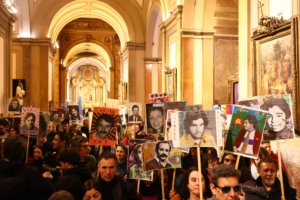 Family members and survivors remembered Nélida Noemí Moreno, José Luis Goyochea, Rosa Cristina Godoy, and Carlos Cruspeire during an emotional Mass. “Today we are a little freer,” they said.
Fifty years later, and 700 kilometers from where Nélida Noemí Moreno, José Luis Goyochea, Rosa Cristina Godoy, and Carlos Cruspeire were abducted, their children, family members, and loved ones were able to be reunited with their remains. It was thanks to the immense work of the Argentine Forensic Anthropology Team (EAAF) that, between March and May, the bodies of 29 people who had been held at the La Perla concentration camp in the province of Córdoba during the dictatorship were identified. They made a pilgrimage to the Nuestra Señora de la Merced parish, where they celebrated a Mass in their memory. “I feel that my parents and Águeda’s parents are free today,” said Mariela Cruspeire, daughter of Rosa and Carlos.
Unconcerned by the hustle and bustle of winter break—which fills downtown Buenos Aires with children and adults flocking to Florida Street—a group of people waits huddled together at the corner of Perú Street and Avenida de Mayo. They hold signs on long poles above their heads, bearing the names and photos of others who are not there. “Disappeared in 1976 and detained at La Perla,” reads one of the many banners. The small speaker of the street vendor selling mate and other handicrafts completes the scene to the beat of “Nos siguen pegando abajo” by Charly García.
Once Águeda Goyochea (daughter of Nélida and José Luis) and Mariela Cruspeire arrive, the conversations fall silent, giving way to applause and emotional hugs, making room for them to take their places at the head of the procession, each holding the small wooden urn that encapsulates more than four decades of struggle and gives meaning to such a ceremony.
“It’s hard to come to terms with the stark reality of such a tiny piece of bone. In my dad’s case, it was a few small bones from his foot. In my mom’s case, even the bone used to identify her crumbled when the sample was taken. In other words, the discovery is deeply shocking, deeply moving, and deeply harsh,” Águeda explains.
Mariela, Águeda, their children, and loved ones walk alongside Teresa “Tina” Meschiati, a survivor of the La Perla clandestine detention center, who spent a great deal of time there with Nélida Moreno. “She looks exactly like her mother,” she says, pointing to Águeda. “When I met her, I was startled—I thought I was looking at Nélida,” Tina adds.
As the procession begins to walk down Avenida de Mayo toward the Casa Rosada, a voice breaks the deathly silence with the chant “Tell us where they are,” quickly taken up by the crowd. Another woman claps her hands in rhythm, and so they make their way to the Metropolitan Cathedral. In silence and with the utmost respect, they enter the cathedral and head to General San Martín’s mausoleum to lay flowers. Once again, the same voice as before, upon the ritual’s conclusion, shouts, “30,000 detained and disappeared comrades,” and the rest respond with the customary “Present!”, bringing tears to the eyes of several of those marching.
Upon arriving at the site of the Mass, those present filled the parish church and were welcomed by Father Alejandro Llorente and Father Paco Olveira. “I don’t know if it’s possible right now to grasp the full impact this will have on us. What we do know—or what we do want, what we’re actually feeling—is that we need to share it. There’s a public dimension to this; it belongs to everyone, or at least it should be something everyone can share,” Águeda Goyochea reflected after the ceremony.
As for the feelings she has been experiencing these past few days, she acknowledged that “it’s a process we’re living through, going through.” However, “on a personal level, it raises many questions for me; there is something that does give me a certain peace or calm—knowing, or confirming, the fact of their death, their execution, and how they were hidden away. “It was something we knew, but this has confirmed it,” she said.
Although she noted that “at a time like this, few words come to mind—it’s all about feeling,” Mariela Cruspeire emphasized the importance of sharing the moment with her loved ones and fellow searchers. “Being together like this is the best thing that could have happened to us on this journey, from the moment we received the news until now,” she said, thanking “everyone for this companionship, which is absolutely healing and necessary.”
“When I received the news, and shortly after I began to process this situation, I felt that my parents and Águeda’s parents are free today. And I believe that we, too, are a little freer today—both as a family and as a society,” she said, visibly moved, and concluded by expressing her hope that “there will be many more tributes and rituals, however each family chooses, from now on.”