
By Pablo Solana on September 21, 2026

Anger, Photo: Enfoque Rojo – La Izquierda Diario
“Defeating Milei” is the goal set by the left, and to that end, it organized the “The March of Anger” across the country. Analysis of a bet on mobilization one year before the next presidential elections
1. The Left demonstrated its social clout in the streets
The march was massive in Buenos Aires and very significant in a dozen other cities, such as Neuquén, Rosario, Mendoza, Mar del Plata, and La Plata. The march that reached Plaza de Mayo included shop steward committees from various unions, artistic collectives, retiree groups, and “individuals,” whose numbers far exceeded those of the political parties.
Myriam Bregman is currently enjoying a surge in popularity; she has the highest positive approval rating among politicians; however, this was not a march in support of her personally. Within the Left and Workers’ Front—Unity (FIT-U), the four constituent parties have their differences, which have become more pronounced recently; nevertheless, all of them mobilized, each with its own profile and organizational structure. The PTS—“Myriam Bregman’s party,” as its activists often introduce themselves in the neighborhoods—did not place special emphasis on her during the march, but rather on the political proposal through which they hope to build on the current wave of popular support: the committees “for a party of the new working class.”
Overall, what was evident was a significant ability to mobilize in an era when large demonstrations organized by political parties are rare.

Photo: Enfoque Rojo – La Izquierda Diario
2. It was a political march, centered on Plaza de Mayo
There weren’t many of this nature during Milei’s three years in office: those on March 24, and several other sector-specific ones (for the universities, in support of retirees or the Garrahan Hospital, against the Land Law, etc.). That is why it is a wise move to call for a march “against the government” without it necessarily being a defensive struggle, without waiting for an attack. Nor have marches to Plaza de Mayo been common in recent years; Congress has monopolized the spotlight of protests over the legislative agenda, but we know that, when it comes time to strike where it hurts the most, our strength and the momentum of the struggle must be directed toward the historic Plaza.
3. The focus is spot-on: anger drives people to take to the streets and organize
“Anger rising from the grassroots,” “the anger of those of us who work and can’t make ends meet”—these were the words heard from the stage. Added to these simple expressions is the inevitable reference to the historic protest song, recently reimagined by the Quinteto Negro La Boca, used as a promotional video and played on the main stage after the document was read. “Organizing the anger” is the idea that lingers: the task at hand.

Foto: Edgardo Gómez – Tiempo Argentino
4. The march gave prominence to organizations rather than to political parties and leaders
It is undeniable that the marches aimed to raise the profile of the left, to showcase it as a political force capable of mobilizing massive crowds, and to consolidate among mobilized activists the positive image indicated by various polls and surveys. Party leaders headed the march, alongside a diverse array of figures from the worlds of culture and human rights. However, the march was organized with a sound approach to the placement of the mobilized social and political forces: first, human rights organizations, retirees, artists, and various social collectives; second, labor unions; and finally, the party contingents. This was a lesson learned from the annual March 24 rallies, well applied.
5. The document proposed clear definitions for the struggle
Agreed upon by various parties and collectives, the document outlined the left’s proposals without going overboard, emphasizing the call to take to the streets (“For the support, unity, and victory of all struggles!”), taking up causes such as the Malvinas (“No joint military bases with the United States. “British out of the Falklands. Yankees out of Latin America”) and Venezuelan and Cuban sovereignty (“We denounce the military incursion into Venezuela, the kidnapping of its president, and the plundering of oil and mining resources. Also, the intensification of the brutal economic blockade against Cuba”). While PTS leaders had been doing this, it is a new development that the FIT-U as a whole has endorsed it; it is well known that other parties hold less “Latin Americanist” positions, so to speak.
Source: Resistencias, translation Resumen Latinoamericano – US
By Hedelberto López Blanch on September 23, 2026

illustration: Adán Iglesias Toledo
Most of those present in the large room of the UN General Assembly were stunned and others were enraged when the new devil of the world, the convicted American president Donald Trump, filled the room with hatred and sulfur. (more…)
September 22, 2026
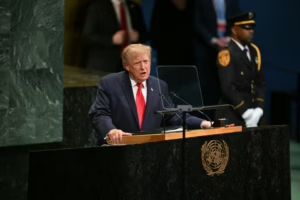
The Donroe Doctrine in Action, foto: Angela Weiss. AFP
The U.S. president took the podium at the United Nations General Assembly to reaffirm that he considers the region his country’s backyard. He cited Venezuela as an example of what he is willing to do and reaffirmed that he will continue to strangle Cuba until the Revolution falls. (more…)
September 22, 2026

An investigation by the nonprofit organization Forbidden Stories revealed that the government allocated $410 million to be given directly to receiving countries or UN agencies to facilitate deportations. Photo: Forbidden Stories.
The United States deported more than 25,000 people under secret agreements with 35 countries to receive migrants who have no ties to those nations, according to an investigation published Monday . (more…)
September 22, 2026
 Cuban Foreign Minister Bruno Rodríguez reacted Tuesday to Donald Trump’s speech before the UN General Assembly and rejected the U.S. president’s claims about Cuba. Trump addressed the United Nations today. (more…)
By Democracy Now on September 22, 2026

Carlos Fernandez de Cossio. foto: Bill Hackwell
As the United Nations General Assembly opens in New York, we speak with senior Cuban diplomat Carlos Fernández de Cossío, who says the Trump administration is seeking to “asphyxiate the people of Cuba into submission.” On Friday, millions in Cuba lost power in what was at least the sixth major blackout since President Trump cut off fuel shipments to the island in January. The fuel blockade comes on top of the six-decade-long U.S. economic embargo and countless attempts to topple the communist government. (more…)
By Gloria Muñoz. La Jornada_Resumen Latinoamericano September 21, 2026.

foto: Bill Hackwell
Thousands of Indigenous people live under siege and in constant vulnerability in the face of organized crime groups operating in collusion with municipal and state authorities and federal security forces in the state of Chiapas. Yes, just as in Guerrero, Michoacán, or Chihuahua, to cite documented examples. The figures on this humanitarian tragedy warrant urgent attention, but what we find instead is institutional denial that only exacerbates the crisis. (more…)
By Alejandra Garcia Elizalde on September 20, 2026

Havana, the author working in darkness. foto: Bill Hackwell
In Gaza, thousands of children have been killed amid the genocide that’s being imposed by Israel with total impunity. Thousands more are unaccounted for and buried beneath the rubble. In Cuba, millions of people have survived for years amid blackouts, shortages, difficulties accessing medicines, fuel scarcity, and a profound economic crisis imposed upon them by the United States. (more…)